
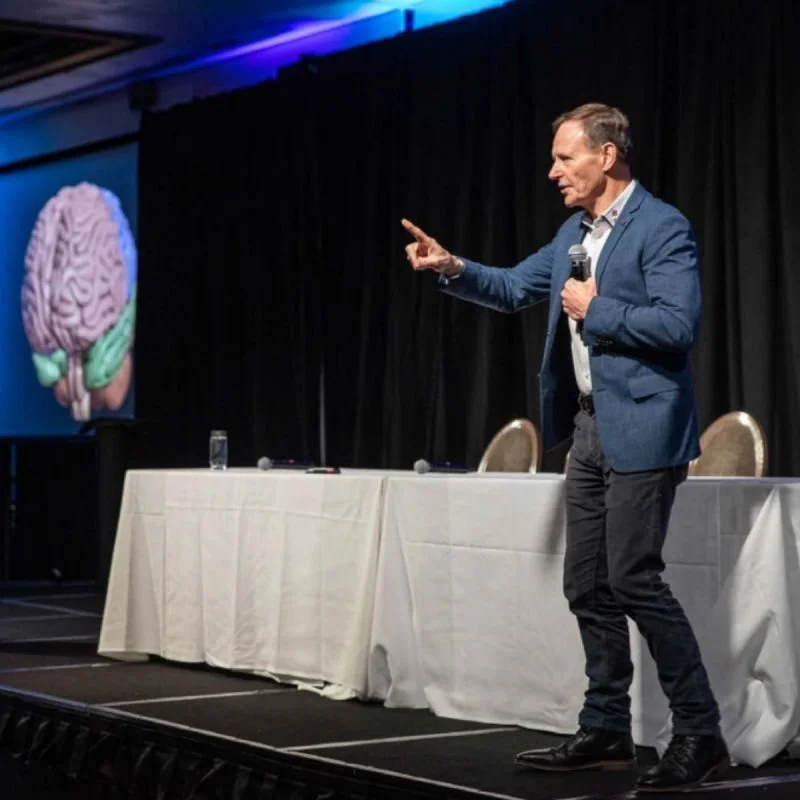
I can't remember my first keynote presentation; it was all a blur. I paced the stage, going through a presentation by simply following the slides. Apparently, it went okay, but I couldn't tell.
I got off stage thinking, “How do people do this for a living?” And then the rush of adrenaline wore off, replaced by dopamine and endorphins, which left me feeling elated.
Having always challenged myself to overcome my fears, I saw it now as a challenge to continue keynote speaking alongside the workshops we were running for businesses.
We know now it is important to overcome our fears, or at least do our best to.
I had a fear of heights, which, ironically, led me to take up skydiving. While it didn’t cure my fear, it was an extreme experience that taught me a lot about myself.
Perhaps it was the near-death experience of hurtling towards earth when all you can think about is pulling the ripcord that brings clarity to every sense.
As a crisis negotiator, undertaking suicide interventions was another fear I had to overcome. How will I start the conversation? How will I keep the conversation going? What if I say the wrong thing?
What if they jump?
Fortunately, no one ever jumped. I again learned a great deal about myself, others, and how to engage in a conversation, no matter how intense it might be.
Keynote speaking hasn’t come naturally to me. Even after years of speaking, I still get butterflies before every keynote.
So why do I keep doing it?
Why do I keep putting myself up on stage under pressure? Why don't I just focus on presenting our workshops in a controlled environment?
It is the challenge to overcome my fears that motivates me.
My largest audience to date for a keynote was over 2000 people, where I was the opening address at a conference. I was told I was the opener just before going onstage. Awesome, that little rush of fear produced an amazing presentation.
These days, I am often asked to open or close a conference, which is truly an honour.
I also love the most difficult time for keynotes, the first speaker after lunch! I refer to that slot as the graveyard shift, as most people are recovering from lunch.
There was a time early on when I decided to stop being a keynote presenter. I viewed the nerves as stress rather than what they should have been – a means to be at my best and overcome the challenge.
As soon as I saw it differently, it became easier. Excitement and anxiety are processed in the same part of the brain and share the same physical symptoms. Perhaps I was simply seeing it wrong.
Whilst I still get nervous before every keynote, it is those nerves that keep me focused, at my best, and provide me with humility.
Stepping out of our comfort zone to overcome our fears is a powerful experience; seeing it differently can be even more powerful.
Let's talk!
Step Outside of Your Comfort Zone!