
Five years ago, I fell awkwardly and badly injured my shoulder, a double injury to my rotator cuff.
After the fall, my brain kept replaying the moment, sometimes even in dreams.
You might know that loop yourself - Why did this happen? What was I thinking? This is my fault.
When something negative happens, the brain automatically replays it to learn from it. It’s trying to protect us from it happening again.
Helpful in theory, damn uncomfortable in reality.
If the replay goes on too long, it can lead to acute stress and, at the extreme end, post-traumatic stress.
Post-surgery, I underwent physiotherapy. Physio is painful, tiring and necessary.
In my workshops, I always ask, “Who here has had physio?” Almost everyone has.
Then I point out, “So you’ve all had therapy then – physiotherapy.”
Why is mind therapy treated differently?
Physiotherapists get us talking about the injury, then apply pressure to the painful part to help it release and heal.
Psychologists do the same for emotional injuries; they help us release the emotion that’s been stuck.
Emotions must come out!
If we don’t express emotions, they don’t disappear; they build.
Talking helps the brain process the event so it can finally move forward.
I openly talk about the fall, the fear and the emotions that came with it. No hiding. No pretending.
And the flashbacks are easing.
Showing vulnerability also allows others to open up. Healing becomes something shared.
Talking about emotional pain should be as normal as talking about physical pain.
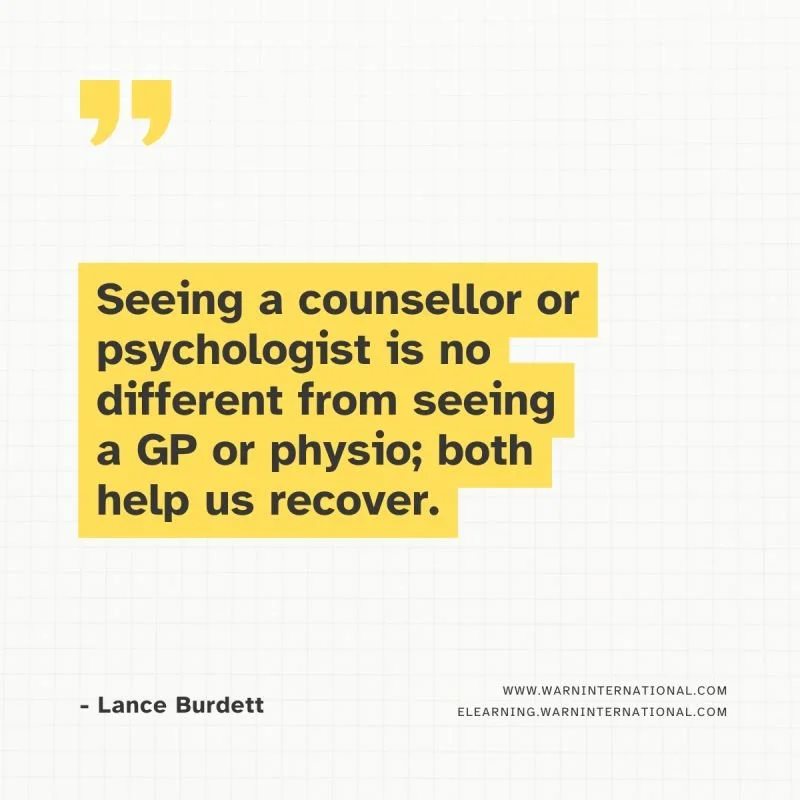
Seeing a counsellor or psychologist is no different from seeing a GP or physio; both help us recover.
Let’s normalise the conversation.
Let’s talk.
Think of Recovery in a Different Way.