
Few people know this, but I once took up skydiving.
Apparently being a police officer didn't provide enough excitement, so I organised for our section to do a parachute jump at the local Air Force Sports Club.
The first jump was incredible, exhilarating, life-changing, a total rush.
Of course, the first jump was easy. I was too terrified to know what was happening.
Living in the moment became living in approximately three seconds at a time.
The second jump was much harder. The first jump is blind panic, while the second jump is ‘informed’ panic.
You suddenly know what can go wrong, and unfortunately, my brain felt obliged to share every possible scenario.
Despite this, I caught the bug. I've always had this strange belief that if something scares me, I should probably do more of it to overcome the fear.
Looking back, that may explain a lot about my childhood.
Eventually I progressed to freefall, a wonderfully descriptive name. A bit like calling turbulence ‘unexpected movement.’
The theory was simple. You jump out of the aircraft, you remain calm, you follow the procedure.
If something went wrong, there were safety systems in place. Easy, what could go wrong?
Unfortunately, my nervous system had no interest in simple. The instructor would say GO, and I reckon my hand was already halfway to the ripcord.
I wasn't free-falling; I was panic-falling and paying for the opportunity - nothing about it was free.
I completed a few more jumps, hoping I'd eventually relax. I didn't; I was terrified.
Did I get a buzz out of it? No. The buzz came from surviving death.
Eventually I told the jumpmaster that my latest jump would be my last. He looked surprised. Why, he said, don't you get a buzz from it anymore?
My reply: No, I'm scared as hell every single time. Then something strange happened, that final jump was perfect.
For the first time ever, I relaxed. I was stable, in control; the horizon sat exactly where it should.
I checked my altimeter, enjoyed the view, pulled the ripcord when I was supposed to. It was everything skydiving enthusiasts talk about.
When I landed, the jumpmaster walked over and said, ‘Now you're ready.’
The next step was a jump with two instructors holding me stable so I could experience the full joy of freefall. He was genuinely excited. Me, not so much.
Mate, I have just spent several years discovering I don't enjoy falling towards Earth at 200 kilometres an hour.
That was the last time I visited a drop zone. It turns out there are easier ways to deal with fear, many of them involve keeping both feet on the ground.
The lesson? People often say growth happens outside your comfort zone, and that's true.
But sometimes wisdom is recognising that your comfort zone was actually making a good point.
After all, if someone told you the activity involved throwing yourself out of an aeroplane and hoping a collection of strings sorted everything out, maybe fear wasn't the problem.
Maybe fear was simply paying attention.
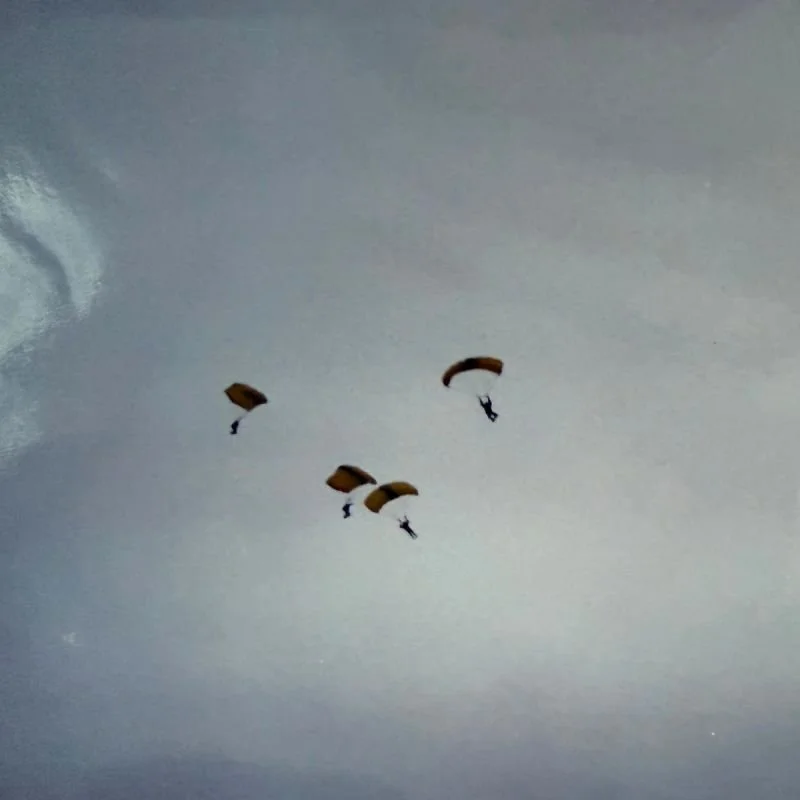
Maybe Fear is Simply Paying Attention.